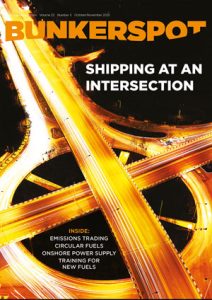
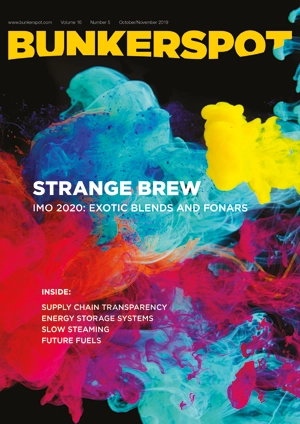
Strange brew
IMO 2020: exotic blends and fonars
GHG Emission Targets
The UK is one of the first major economies to legislate for net zero emissions, with a 2050 target. Lesley Bankes-Hughes looks at how the UK government is expecting shipping to follow its roadmap for a cleaner and greener environment.
Fuel Oil Non-availability Report
With the prohibition on using non-IMO 2020 compliant fuels coming into force on 1 January 2020, Steve Simms of Simms Showers takes a forensic look at FONARS.
BunkerTrace
Technology innovators Forecast Technology Ltd and BLOC have pooled their cutting-edge solutions and expertise to deliver BunkerTrace. Designed to ‘track and trace’ the marine fuels supply chain, the technology provides much-needed transparency and traceability every step of the way in the bunker delivery process – and, as Lesley Bankes-Hughes reports, this is only the tip of the iceberg in terms of realising BunkerTrace’s full potential.
Shipping Finance
The launch of the Poseidon Principles is a clear sign that some banks are taking positive action to address the environmental footprint of their shipping finance portfolios. However, as Alison Weal, partner at Winston & Strawn, points out, if more capital providers do not sign up to the Principles shipowners with high carbon-intensity tonnage could source their capital elsewhere.
Company Profile: BunkerTrust
BunkerTrust is working to bring greater transparency into refuelling operations through its platform which allows stakeholders to rate the bunker delivery performance. As company CEO Daniel Kampmann tells Lesley Bankes-Hughes, improving fuel supply chain visibility can be a commercial and operational win-win.
IMO 2020
- The prospect of new fuel blends entering the bunker pool as a result of the upcoming IMO 2020 regulations has sparked a heady mixture of expectancy and concern among shipowners. Steve Bee of VPS argues that preparation and careful fuel management will be crucial in coping with the transition.
- With IMO 2020 likely to push up the cost of bunker fuel, BIMCO’s Peter Sand asks how the shipping industry can pass on the fuel bill to customers.
- Ian Taylor asks whether Africa’s ports and its vital offshore bunkering sector are ready for the shift towards low sulphur marine fuel.
Future Fuel
As shipping navigates a path to CO2 and GHG reductions, this is a difficult time to make choices on fuels. UCL Energy Institute’s Tristan Smith looks at the options available and considers what can be done today to meet future targets.
Biofuels
Sustainability and environmental responsibility have been the guiding principles of the shipping company Meriaura since it first started business more than 30 years ago – and now the company is helping its customers demonstrate their green commitment with biofuel-powered ships.
Slow Steaming
Faig Abbasov of Transport & Environment argues that slow steaming is a ‘no regrets’ option for helping to reduce the shipping industry’s emissions.
Propulsion Systems
With close to three decades and over 15 million running hours, the Azipod propulsion system has become an industry standard as ships push into remote areas and face more pressure on fuel efficiency than ever before, writes ABB’s Antti Ruohonen.
Energy Storage
Sean Puchalski of Corvus Energy tracks the key turning points and innovations that have contributed to the growing interest in batteries for marine electrification.
Maritime Training
LNG is increasingly being seen as a viable fuel option for shipping companies that want to reduce their emissions but, as GTT’s Ray Gillett reports, ships’ crews need to be trained on how to manage the new fuel.
Marine Security
As West Africa becomes the hotspot for maritime security concerns, Gray Page’s Nick Jameson warns that piracy will continue as long as ships leave themselves vulnerable to attack.
Scrubbers
Reliable, consistent monitoring solutions can play a vital role in assessing the efficacy of exhaust gas cleaning systems, argues Emma Johnson of Chelsea Technologies.