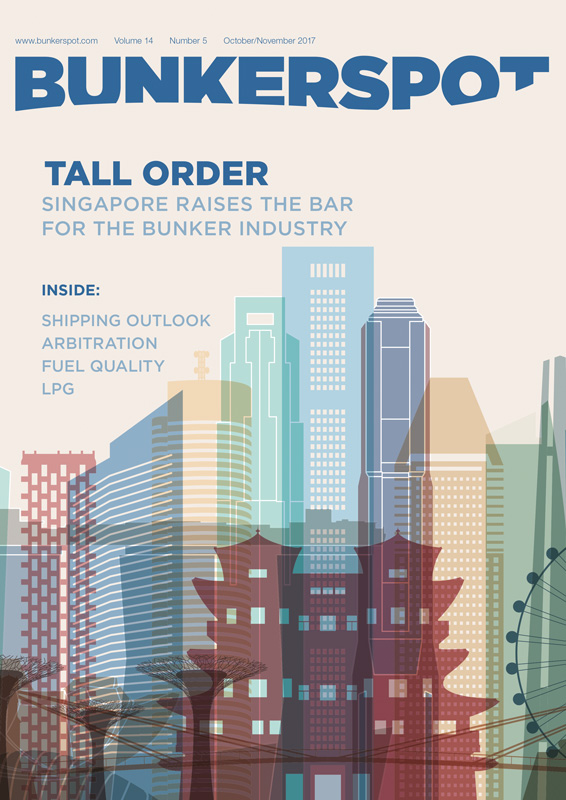
TALL ORDER
SINGAPORE RAISES THE BAR FOR THE BUNKER INDUSTRY
Regional Focus: Singapore
Singapore is by far the highest volume bunker supply port in the world and is a hugely important regional refining and oil storage hub. Bunkerspot provides a snapshot of the current state of play in the Asian hub’s bunker market
Mass Flow Meters
Gabian Chew canvasses the views of Bernhard Schulte Shipmanagement, BW Group, China Navigation, Pacific International Lines, Teekay Tankers and the Singapore Shipping Association to discover what makes the use of mass flow meters in bunker deliveries appealing to bunker buyers
OW Bunker
From the launch of OW Bunker’s ostensibly hugely successful IPO to its spectacular collapse into bankruptcy took but a matter of months, however the legal repercussions look certain to stretch out over many years to come. Lesley Bankes-Hughes explains how institutional investors and retail shareholders are taking steps to recover their losses following OW’s demise
The bankruptcy of OW Bunker in 2014 and Hanjin Shipping’s market exit last year together provided a salutary – and long overdue – wake-up call for the bunker industry and wider maritime sector. Steve Simms of Simms Showers reviews the subsequent legal and commercial changes and actions that have wrought further upheaval in the shipping world in such a short space of time
Arbitration
After a period of rapid growth, Fujairah has become one of the top three global bunkering locations, and, as Richard Briggs explains, the Emirates Maritime Arbitration Centre is now ready to support its position as a major marine fuel supply hub by providing a forum for maritime dispute resolution
Shipping Outlook
At long last, shipping seems to be allowing itself to ride on a small wave of optimism. But, as Fotios Katsoulas of Affinity Research explains, while there is better news for freight rates and some vessel sectors, uncertainty and caution still remain endemic in the industry
LNG
The recent christening of Shell’s new LNG bunker barge, Cardissa, at the Rotterdam Cruise Terminal provided a platform for the oil major and other industry stakeholders to discuss their plans and perspectives on the emergence of a new marine fuels landscape. Lesley Bankes-Hughes reports back on the topics discussed at the event
New Fuels
The bunker industry is gradually opening up to fuels which are outside the traditional residual and distillate product categories. Here, Hendrik Brinks of DNV GL offers an overview of the potential benefits and challenges of using LPG as a marine fuel
Environment
With the number of exhaust gas cleaning system installations expected to rise, Rhys Berry examines the options for closed-loop technology operators who need to dispose of scrubber waste
Fuel Issues
In recent years, sales of 500 cSt heavy fuel oil have risen sharply. Rhys Berry examines this trend and asks whether the popularity of cheaper, higher viscosity residual grades – used in operation with a scrubber – is set to increase post-2020
The 2020 global 0.5% sulphur cap will be the catalyst for the introduction of a range of compliant blended fuels. As Aderco Group Technical Director Olivier d’Olne highlights, the different chemical composition of such products may lead to an increase in fuel incompatibility
In the coming years, vessel traffic along the two main Arctic routes – the Northern Sea Route and the Northwest Passage – could increase dramatically. However, as Albert Leyson of Drew Marine discusses, there is, as yet, scant regulation governing the use of bunker fuel in this region and minimal effort in addressing black carbon emissions
The bunker sector is braced for change as the industry prepares for a new global low sulphur limit, which comes into effect in early 2020. Francesca Cupellini, Infineum Fuels Market Development Advisor, looks at the potential marine fuel quality issues that could arise and highlights where additives can be used to help overcome them
Risk Management
Certas Energy’s Head of Risk and Marine, Varun Chhabria, explains the company’s approach to risk-based pricing in today’s complex and cost-sensitive fuel environment