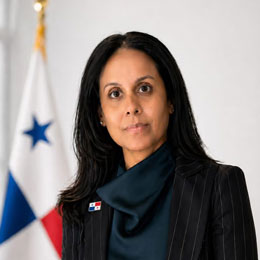
Ambassador & Permanent Representative of Panama
International Maritime Organization
Ms. Testa Barnett is the Ambassador and Permanent Representative of Panama to the International Maritime Organization (IMO). With expertise in international maritime law, regulatory affairs, and diplomacy, she has been instrumental in shaping maritime policy and advancing Panama’s interests at the global level.
Ms. Testa Barnett has represented Panama in numerous IMO committees and working groups, where she contributed to the development of international maritime conventions. She also served as Technical Adviser to Panama’s delegation at the IMO, playing a key role in formulating maritime policy and legal frameworks. Additionally, she chaired the Executive Committee of the International Oil Pollution Compensation Funds (1992 Fund), overseeing negotiations on complex compensation claims.
Ms. Testa Barnett provided legal counsel in maritime compliance, corporate law, real estate transactions, and franchise development, leveraging her expertise in international business and commercial law. In addition to her legal and diplomatic career, she is also an entrepreneur in the food business, reflecting her interest in innovation and business development beyond the maritime sector.
Ms. Testa Barnett holds a Master’s degree in Maritime Law and Shipping Business from ICADE Universidad Pontificia de Comillas (Madrid, Spain) and a Law and Political Science degree from Universidad de Panama.
Her career reflects a strong commitment to public service, maritime law, international cooperation, and entrepreneurship, positioning her as a significant contributor to both the global shipping industry and the business community.