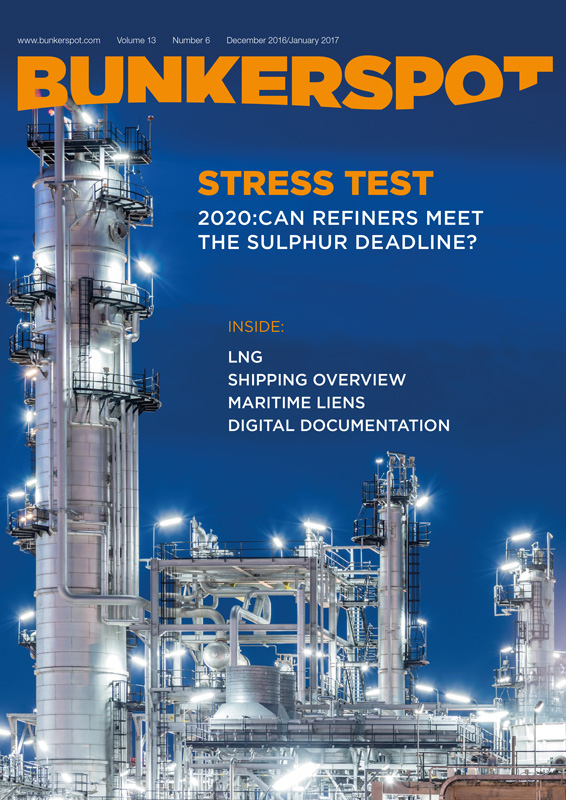
SULPHUR REGULATIONS
Lesley Bankes-Hughes canvasses opinion on just how ‘disruptive’ the 2020 global sulphur cap will be for oil refiners.
The IMO’s decision to introduce a 0.50% global sulphur cap has unleashed a plethora of questions, options and uncertainties for shipping. Robin Meech of Marine and Energy Consulting Limited cuts through the industry ‘noise’ and focuses on the key issues to be considered in the run-up to 2020.
LNG
Lesley Bankes-Hughes talks to Carnival Corporation and Shell about the drivers for growth in the LNG-fuelled cruise sector and the importance of cross-industry collaboration.
Rhys Berry speaks to some ‘traditional’ bunker suppliers to learn how they are putting together strategies and alliances so they can become part of the new marine LNG network.
ENGIE gives an overview of the properties and characteristics of LNG, with particular reference to onboard storage conditions and its use as a bunker fuel.
INTERVIEW: FURETANK
The choice between retrofitting an existing vessel to run on LNG and opting for a newbuild represents a tricky dilemma for shipowners operating within tighter financial margins and increasingly stringent environmental regulations. Rhys Berry speaks to Furetank, a company which has decided to explore both options.
SHIPPING REVIEW
Fotios Katsoulas of Affinity Shipping reviews the lacklustre fortunes of the container, dry bulk and tanker sectors in 2016 and looks at indicators for shipping’s health in the coming year.
INSURANCE
The extension of credit underpins the bunker industry’s business model but it is also one of the sector’s weakest links. As another ‘too big to fail’ shipping company goes under, Adrian Jones of Markel says that credit insurance can be a prudent risk management resource.
Justyn Hardcastle of TokioMarine explains that the maritime industry has its own vulnerabilities to cyberattack and cyber insurance can offer a key line of defence.
TECHNOLOGY
Jeff Mildner of Vortex Development Group explains how the company is working to bring the paperwork and commercial exchanges associated with marine fuel deliveries and safety checklists into the digital world.
MARITIME LIENS
As the repercussions of the bankruptcies of OW Bunker and now Hanjin Shipping continue to be debated in numerous courts, attention has turned to the efficacy – or otherwise – of the maritime lien. James Kennedy of Clyde & Co takes a closer look at this curious, and complex, legal instrument.
REGULATION & COMPLIANCE
Enforcement of compliance with the 0.50% global sulphur cap in 2020 will be a tough call. Steve Simms suggests that creating a framework of effective economic disincentives to violating the regulations could be a useful way forward.
FUEL QUALITY
The implementation of the 0.5% global sulphur cap in 2020 is likely to spur the introduction of a range of blended fuels to achieve compliance. Chris Fisher of Brookes Bell explains that these changes will have an impact on fuel quality and charterparty agreements.
Francesca Cupellini, Fuels Market Development Advisor at Infineum, discusses the challengespresented by the introduction of the global 0.5% sulphur cap.
NOX REGULATIONS
Compliance with IMO Tier III regulations will require significant reductions in NOx emissions within ECAs. As MAN Diesel & Turbo explains, this cannot be achieved by engine modifications alone.
MARKET OVERVIEW: PANAMA
Rhys Berry finds out that there are early signs that the volume of some bunker stems is being scaled up at the recently expanded Panama Canal.
MARKET OVEVIEW: TOKYO BAY
Lesley Bankes-Hughes profiles the ports in Japan’s Tokyo Bay region. The country’s largest bunker market, this area is also the location of a major oil refining hub which is on the cusp of a period of major consolidation.
INTERVIEW: COMFIN SOFTWARE
Gerald Neher, MD of Vienna-based ComFin Software, talks to Gabian Chew about what it takes to be a top trading and risk management solution provider.