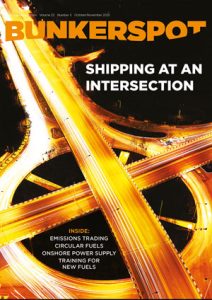

COUNTRY FOCUS: PANAMA
Panama’s bunker market is expanding while many others are stagnant or shrinking. Is the newly-expanded Panama Canal solely responsible for this growth in business or are other factors at play?
MARINE LUBRICANTS
Caroline Huot, Global Head of Lubricants at Cockett Group, reviews recent changes in the marine lubes industry and explains to Lesley Bankes-Hughes why the sector is becoming an increasingly pivotal player in the new multi-fuel world.
Recently appointed Total Lubmarine General Manager, Robert Joore, outlines the international marine lube specialist’s response to a multi-fuel era in shipping.
LEGAL ISSUES
Steve Simms of Simms Showers explains that a fuel buyer or seller should not delay in gaining some familiarity with often unexpected demurrage costs.
Mathias Steinø of Hafnia Law explains that the validity of claims to pledged bunker debts can become a hotly contested issue when it comes to court judgments delivered in different jurisdictions.
COMMERCIAL ISSUES
Neil Lamerton of Oceanic Energy says there is still a very persuasive case to be made for using a pure broker when buying and selling bunkers.
As the bunker sector continues to ‘manage’ its inherent risks, in part by shortening the fuel transaction chain, Adrian Tolson of 20|20 Marine Energy discusses the ongoing recalibration among its key players.
DESULPHURISATION
Neil Camarta of Field Upgrading explains how the company’s DSU desulphurisation process directly produces low sulphur fuel from bottom of the barrel residue or high sulphur fuel oil.
REGULATIONS
In August, ship operators will have to submit their monitoring plans in relation to the EU’s regulation on the monitoring, reporting and verification of vessel fuel consumption data. As Julien Dufour of Verifavia explains, the task facing owners and accredited verifiers is considerable – but not insurmountable.
ENVIRONMENT
Simon Bennett of the International Chamber of Shipping says the organisation plans to set out some key carbon reduction objectives during 2017.
With no clear regulatory plan to address greenhouse gas emissions from shipping on the horizon until at least 2018, James Mitchell, Senior Associate at Carbon War Room, considers what can be done to incentivise low-carbon shipping.
SULPHUR REGULATIONS
Iain White, Global Marketing Manager, ExxonMobil Marine, took part in a Q&A with Bunkerspot on the potential implications of the 2020 0.5% global sulphur cap.
ALTERNATIVE FUELS
Roger Göthberg of MAN Cryo discusses how the company is building its core competencies in cryogenic technologies to deliver an extensive and flexible range of LNG and other bunkering solutions.
BATTERY-POWERED VESSELS
Johan Roos of Interferry acknowledges that electricity may be a ‘niche’ propulsion proposition, but for the ferry sector it is proving to be a viable, reliable and, above all, very clean solution.
SCRUBBERS
As 2020 draws closer, Rhy Berry speaks to scrubber manufacturers to see if they are now making headway in convincing shipowners of the business case for scrubber technology.
FUEL QUALITY
Gunnar Kjeldsen of Bureau Veritas looks at recent trends in off-spec fuel samples – and also highlights how density readings can have significant cost implications.
FUEL MANAGEMENT
Operators are increasingly looking for smart solutions to optimise the monitoring and reporting of marine fuel deliveries. And yet, as FUELTRAX explains, they are often in the dark when it comes to understanding what drives reliable and transparent marine fuel management.
CONDITION MONITORING
Larry Rumbol of Parker Kittiwake discusses the benefits of using condition monitoring tools.
MASS FLOW METERS
Another major port in Asia is also adopting the use of mass flow meters. Gabian Chew reports.