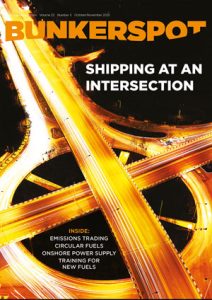

INTERVIEWS
Players in the marine fuel supply chain are having to adapt in the light of ongoing global regulatory, economic and geopolitical changes. Cem Saral, CEO of Cockett Group, explains to Lesley Bankes-Hughes how the group is responding to this new – and challenging – world order.
Jan Christensen, Bomin’s global head of operations, explains that recent group decisions have been a pragmatic and necessary response to market conditions.
As group credit manager with OceanConnect Marine, Can Ertem is well-placed to assess the current ‘fault lines’ in the marine fuels and shipping sectors.
COMMERCIAL ISSUES
As recent global political events have shown, a willingness to believe in ‘post-truths’ can serve to obfuscate the facts. In his postscript to post-truth, Steve Simms of Simms Showers also uncovers some of the common ‘fallacies’ that persist in shipping and the bunker industry.
The early days of Donald Trump’s presidency have already demonstrated that his ‘management style’ is very different from that of his predecessors. With this in mind, Chris Thorpe considers what might be expected from the new administration’s energy policy.
EMISSION REGULATIONS
Two years on from the introduction of 0.1% sulphur emission control areas, Rhys Berry looks at the evidence in relation to enforcement measures and non-compliance, and assesses the prospects for compliance with the upcoming global sulphur cap.
MASS FLOW METERS
Gabian Chew talked to some of the key players in the bunker supply chain at the Port of Singapore to gauge their initial response to the introduction of MFM technology in fuel oil delivery operations.
The mandatory use of mass flow meters for fuel oil deliveries in Singapore is intended to introduce transparency in bunker operations and eliminate malpractice. In this ‘new’ era of bunker fuel measurement, Capt. Rahul Choudhuri of VPS highlights how the bunker surveyor has a redefined but still essential role.
Timothy Cosulich of international bunkering firm Fratelli Cosulich provides useful clarification on the ‘explanations’ which are being passed on to shipowners by some suppliers to justify charging higher premiums for mass flow meter bunkering operations.
A strong case for the use of mass flow meters in bunker fuel deliveries was put forward at the recent Middle East Bunkering Convention. Lesley Bankes-Hughes highlights some of the industry viewpoints expressed at the event.
BUNKER SURVEYS
Jeroen de la Bella of Petro Inspect Europe BV talks to Rhys Berry about the important – and evolving – role of the bunker surveyor in the fuel delivery process.
LNG
SEALNG believes that a collaborative approach to understanding and then tackling the barriers to LNG use is crucial to encouraging investment and continuing to stimulate innovative solutions. Peter Keller, chairman of SEALNG and executive vice president of TOTE Maritime, explains why.
FUEL QUALITY
Intertek ShipCare statistics indicate a rise in the number of off-spec fuel samples in 2016 and some volatility in fuel quality. As Michael Green explains, the variations are not enough to trigger serious concern, but the outlook for fuel quality may become increasingly unsettled in the run-up to 2020.
COUNTRY FOCUS: FINLAND
As shipping faces new economic and regulatory headwinds, Finland is focussed on how to keep its maritime sector ahead of the competition and always with a firm focus on environmental sustainability.