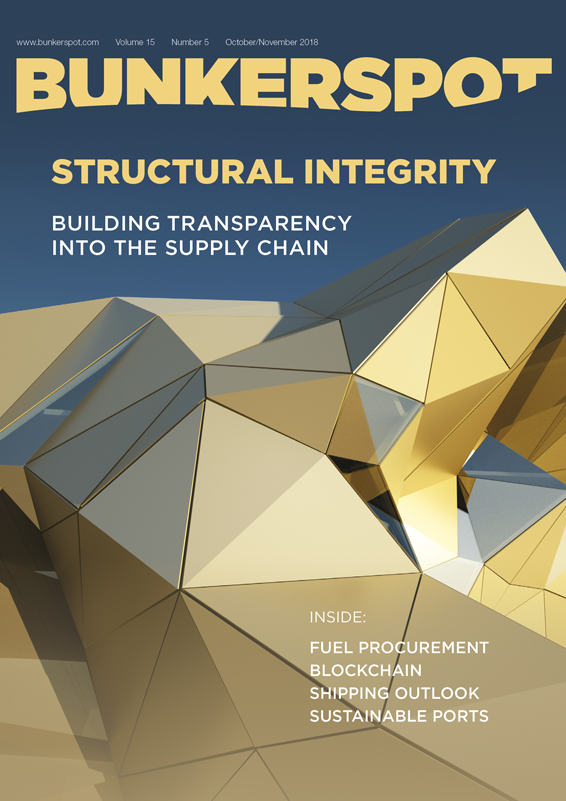
STRUCTURAL INTEGRITY
BUILDING TRANSPARENCY INTO THE SUPPLY CHAIN
Shipping Overview – Dry Bulk & Tankers
The fortunes of the dry bulk and tanker markets have polarised this year and, as Fotios Katsoulas of Affinity Research discusses, the looming threat of trade wars, growing protectionism and the effect of IMO 2020 will all inject further volatility into the demand side.
Interview – Glander International Bunkering
Carsten Ladekjaer, CEO of Glander International Bunkering, tells Lesley Bankes-Hughes that while bunker sector consolidation is still an ongoing process, the role of the trader will increase in importance after the 2020 watershed.
Fuel Procurement
Bunker purchasing will become an increasingly complex and cost-critical function from 2020. Alok Sharma of Inatech explains that ship owners who fully integrate their fuel procurement operations within their corporate-level commercial and financial strategies can achieve a clear competitive edge.
Portugal Shipping Week
Ancient and Modern.
SIBCON 2018
Singapore is the world’s highest-volume and busiest bunkering hub, despite the occasional hint that other ports may soon begin to offer a little extra competition. Llewellyn Bankes-Hughes reports back on the hot topics under discussion this year.
Mass Flow Meters
Darrick Pang of Metcore International offers some insights into the impact that mass flow meter technology is having on the global bunker industry.
Blockchain
Blockchain technology is described as a ‘business disruptor’, bringing increased transparency and traceability into global supply chains. Lesley Bankes-Hughes offers a progress report on the work of a cross-sector initiative to introduce blockchain into marine fuel supply operations.
Regulation & Sanctions Compliance
Simon Ring of Pole Star explains how new regulatory technologies can play a key role in areas such as vessel screening and tracking sanctions compliance.
Cyber-security
Digitalisation and cutting-edge technologies are transforming shipping’s commercial and operational processes. However, as Sjaak Schouteren of JLT Speciality highlights, such rapid and sophisticated innovation in the marine supply chain heightens the risk of cyber-attacks.
Sustainability Focus
Rhys Berry meets the Port of Barcelona’s Jordi Vila to discuss the challenges of driving down port emissions against a backdrop of rising cruise ship traffic.
Rhys Berry speaks to Daniel Dagenais of the Port of Montreal to learn about some of the ambitious initiatives the port has introduced to improve air quality; and to Guillaume Brossard of Energir about LNG bunkering initiatives in the region.
LNG
Jan Schubert of Nauticor tracks the development of the company’s LNG supply infrastructure in northwest Europe – a template which it is hoping to replicate on a wider scale.
Andrew Stafford of Trelleborg Marine Systems UK discusses the linking of emergency shutdown systems during LNG transfers, including bunkering operations.
IMO 2020 – Lubricants
The 0.50% global sulphur cap will create challenges over the selection and availability of marine lubricants. Serge Dal Farra outlines Total Lubmarine’s holistic and proactive approach to solving the 2020 conundrum
NOx Emissions
While compliance with IMO 2020 requires shipowners to decide on fuel and technology choices, it is the task of engine manufacturers to provide solutions to meet NOx emissions regulations. Rhys Berry looks at the pros and cons of SCR and EGR technologies.